Your Winter Home Maintenance Checklist, Tuned to Where You Live
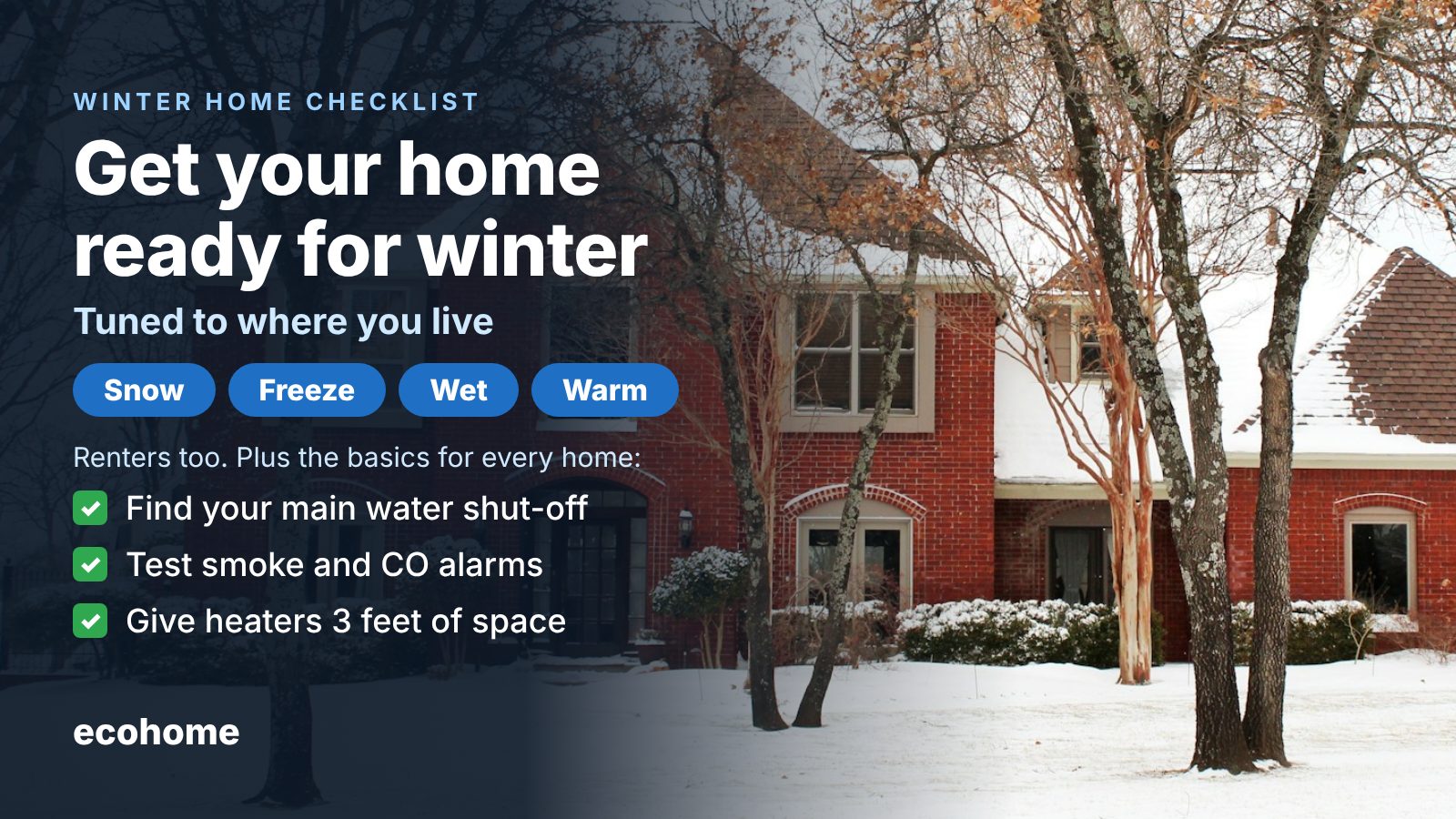
Winter jobs depend on where you live. This winter home maintenance checklist starts with what every home needs, then jumps to your climate: snow and hard freezes, the occasional freeze, mild and wet, or warm winters.
A winter checklist for Buffalo looks very different from one for Seattle, Dallas or Tampa. A few jobs apply almost everywhere, so those come first. Worked through our fall home maintenance checklist? Some of this will look familiar, and that’s the point: winter is when those fall jobs pay off.
Each tip links to the official source it comes from. If your appliance manual, landlord or local rules say something different, follow those.
Winter home maintenance checklist: the quick list
- Find your main water shut-off and make sure everyone knows where it is.
- Test smoke and carbon monoxide alarms every month.
- Check the furnace or heat pump filter every month.
- Keep anything that can burn 3 feet from heaters, fireplaces and candles.
- Run generators outdoors only, at least 20 feet from the house.
- Protect pipes in cold snaps: open sink cabinets, drip a faucet, and keep the heat steady.
- Going away? Leave the heat on at 55°F or higher.
- Keep gutters, downspouts and outside vents clear of ice, snow and debris.
Key takeaways
- Do the every-home basics first, then add the jobs for your climate.
- If a pipe bursts: shut off the main valve, then call a plumber.
- Renters: your lease and local law decide which jobs are yours, but reporting heating or pipe problems fast is usually on you.
Jump to your winter: Every home · Snow and hard freezes (Buffalo, Chicago, Denver) · The occasional freeze (Dallas, Atlanta, Phoenix) · Mild and wet (Seattle, Portland) · Warm winters (Tampa, Houston, San Diego) · Going away · Frozen or burst pipe · Renters · FAQ
Renting? Read the basics and your climate section, then jump to the renter checklist.
Every home: the winter basics
Find your main water shut-off
FEMA’s winterizing guide says to learn how to shut off the main water valve in case of emergency. If a pipe bursts, every minute counts. Find the valve now and show everyone in the house. Turn it gently. If it’s stuck or drips at the stem, have a plumber replace it now rather than during an emergency. The same guide suggests considering water-leak sensors or an automatic water shut-off.
Smoke and carbon monoxide alarms
- The CPSC’s winter safety tips say to put CO alarms on each level of the home and outside separate sleeping areas, and to test CO and smoke alarms monthly.
- The CPSC also recommends interconnected alarms, so when one sounds, they all sound. If a CO alarm goes off, get outside and call 911.
Furnace or heat pump filter
ENERGY STAR says to check the air filter once a month, and to clean or replace it when it’s dirty. Your system works hardest in winter, so this is the recurring job most worth a reminder. Write the filter size down where you’ll find it.
Space heaters, fireplaces and candles
The U.S. Fire Administration says heating was the second-leading cause of home fires in 2021. From 2017 to 2019, portable heaters were behind only 3% of home heating fires but 41% of the deadly ones.
- Keep anything that can burn at least 3 feet from fireplaces, wood stoves, radiators, space heaters and candles.
- The CPSC says to plug space heaters straight into a wall outlet, never a power strip, and not to run the cord under a rug.
- Turn space heaters off when you leave the room or go to bed. Never use the oven to heat your home.
- USFA says to have chimneys and heating equipment cleaned and inspected by a professional once a year. If you skipped it in the fall, book it before you light the first fire.
- Put fireplace ashes in a metal can with a lid, and keep it outside, away from the house. Ashes can stay hot for days.
Power outages and generators
Winter storms knock out power in every climate. The CPSC says to run portable generators outdoors only, at least 20 feet from the house, with the exhaust pointed away from doors and windows. Never run one in a garage, basement, shed or crawl space, even with the doors open. The CPSC reports nearly 100 deaths a year in the U.S. from carbon monoxide from portable generators.
Never plug a generator into a wall or dryer outlet to power the house. That can send power back down the line to utility workers. If you want a generator to run household circuits, have an electrician install a transfer switch. During an outage, use flashlights or battery candles instead of real candles.
Heat for less
The Department of Energy says turning the thermostat back 7°F to 10°F for 8 hours a day, while you sleep or are out, can save up to 10% a year on heating. It also suggests opening curtains on sunny days and closing them at night. One exception: during a deep freeze, the Red Cross says to skip the night setback if you have pipes at risk (see below).
Put the monthly filter check and alarm tests on autopilot. ecohome’s free maintenance reminders remind you 7 days before each job and on the day. Get ecohome free.
Snow and hard freezes
For the Northeast, Midwest, Mountain West and Alaska, winter is about pipes, roofs and snow.
- Keep pipes warm. The Red Cross says to keep garage doors closed if water lines run through the garage, open kitchen and bathroom cabinet doors so warm air reaches the plumbing, and let cold water drip from faucets served by exposed pipes in very cold weather.
- Same setting day and night. In a cold snap, the Red Cross says to keep the thermostat the same day and night. Your bill may go up a little, but a burst pipe costs far more.
- Hoses off. If a hose is still connected, disconnect and drain it. A hose left on can trap water in the faucet and freeze it.
- Heat tape. The Red Cross suggests UL-listed heat tape or heat cable for exposed pipes. Follow the maker’s directions exactly: plug it into a GFCI outlet, and don’t overlap or cover it unless the label allows.
- Ice dams. Michigan’s emergency management guide to ice dams says warm air leaking into the attic is usually the cause. It recommends good attic insulation, airflow from the soffits to the roof vents, and clear gutters and downspouts. Big icicles along the eaves are a warning sign.
- Snow on the roof. The same guide suggests a long-handled roof rake used from the ground. Look up before you rake, and keep the pole well away from the power line to the house. Don’t climb onto a snowy roof.
- Shovel smart. The American Heart Association says pushing snow is easier on your heart than lifting it. Start slowly and pace yourself. If you have heart disease or its risk factors, let someone else clear the snow. Stop if you feel chest pain or pressure, lightheadedness or an irregular heartbeat, and call 911 if it doesn’t ease quickly.
- Fuel and vents. FEMA’s winterizing guide says to fill fuel tanks and watch the level through the winter, and to keep vents clear. After a storm, clear snow from the outside vents for the furnace, water heater and dryer, and from around the gas meter.
- Sump pump. Before the spring thaw, pour a bucket of water into the sump pit and make sure the pump switches on.
Renting? Dripping faucets and opening cabinets are on you. Attic, roof and gutter work is usually the landlord’s, so report big icicles or ceiling stains fast.
The occasional freeze: how to prevent frozen pipes
Across much of the South and Southwest, a hard freeze might come a few nights a year. Homes there often have pipes in exterior walls, attics or crawl spaces with little insulation, so a single cold night can do real damage. Watch the forecast. In the US, ecohome can show National Weather Service alerts for your ZIP code, so a freeze warning doesn’t sneak up on you.
Freeze in the forecast tonight?
- Disconnect and drain hoses, and cover outdoor faucets.
- Open the sink cabinets on outside walls.
- Let a faucet on an outside wall drip cold water.
- Keep the heat at the same setting overnight.
- Know where your main water shut-off is. If a pipe freezes anyway, see how to thaw it.
- Outdoor faucets and hoses. If you didn’t do it in the fall, the Red Cross says to disconnect, drain and store hoses. If there’s an indoor shut-off for an outdoor faucet, close it and leave the outside faucet open so the water can drain. Foam faucet covers from the hardware store help too.
- Wrap exposed pipes. The Red Cross suggests pipe sleeves or UL-listed heat tape or heat cable on exposed pipes. In a pinch, even ¼ inch of newspaper helps.
- Pools and sprinklers. Follow your installer’s directions for pool pumps and irrigation lines. The Red Cross says not to use antifreeze in them unless the directions say to.
Renting? Before a freeze, ask your landlord who handles outdoor faucets and exposed pipes, and what they want you to do on freeze nights.
Mild and wet
In the Pacific Northwest and along the northern California coast, winter means months of rain, wind and the odd snow day.
- Gutters and downspouts. FEMA’s winterizing guide says to keep gutters clear and make sure downspouts carry water away from the foundation. Check them from the ground during a heavy rain, not after. Nobody belongs on a ladder in wind and rain.
- Roof and attic. The same guide says to look for broken, curled or missing shingles and damaged flashing, and to check the attic for water stains.
- Condensation and mold. The EPA’s guide to mold and moisture suggests keeping indoor humidity below 60%, ideally between 30% and 50%. Run bathroom and kitchen fans, and wipe window condensation in the mornings.
- Sump pump. If you have one, test it before the wettest months by pouring a bucket of water into the pit.
- Windstorm outages. Trim branches that hang over the roof, and review the generator safety tips above before the first big storm.
Renting? Running the fans and wiping condensation are on you. Report roof leaks, attic or ceiling stains and overflowing gutters.
Warm winters
In Florida, the Gulf Coast, southern Arizona and Southern California, winter is the easy season, which makes it a good time for the jobs that are miserable in summer.
- Test the heat before you need it. Run your heat pump or furnace for a few minutes before the first cool night. A brief burning-dust smell is common. A smell that doesn’t go away is a reason to call a technician. If you smell gas, leave the house and call the gas company from outside.
- Book the AC service now. ENERGY STAR recommends a professional check-up for the cooling system each spring. In warm climates, winter is when technicians have openings.
- Still watch for freezes. Desert nights and Gulf Coast cold fronts can dip below freezing. Keep the occasional freeze steps handy.
Renting? Ask when the AC was last serviced, and report heat that doesn’t work before you need it.
Going away this winter
- Leave the heat on at no lower than 55°F, as the Red Cross advises.
- Ask someone to check the house, especially after a cold snap or a power outage.
- Consider a water-leak sensor or an automatic water shut-off, as FEMA’s winterizing guide suggests.
- Leave your contact details and the location of the main water shut-off with whoever checks in.
How to thaw a frozen pipe (and what to do if it bursts)
A trickle from a faucet when it’s freezing outside often means a frozen pipe. The Red Cross says:
- Keep the faucet open so water can flow as the ice melts.
- Warm the pipe with a hair dryer, an electric heating pad, towels soaked in hot water, or a space heater kept away from anything that can burn.
- Never use a blowtorch, kerosene or propane heater, charcoal stove or any open flame.
- Keep heating until full water pressure is back, and check your other faucets. If you can’t find or reach the frozen spot, call a licensed plumber.
Keep cords, hair dryers and heaters out of any standing water. If the pipe has already split, shut off the main water before you thaw it, or it will flood as the ice melts.
If a pipe bursts, shut off the main water valve first, then call a plumber. If water is near outlets, cords or the electrical panel, don’t walk through it. Shut off the power at the breaker only if you can reach it from somewhere dry; otherwise call your utility. Take photos of the damage before cleanup for your insurer. It helps a lot if you’ve already documented your home for insurance and kept your receipts and warranties in one place. ecohome keeps both, free.
Winter checklist for renters
If you rent, your lease and local law decide which of these jobs are yours. The rules vary by place, but a few things are usually on you:
- Ask your landlord where the main water shut-off is, and who to call after hours for a burst pipe or no heat.
- Report heating problems, leaks and failed alarm tests right away, in writing, and keep a copy.
- No reply? Your city or state housing office can tell you what heat and repair rules apply where you live.
- If the heat goes out overnight, report it in writing, and use a space heater only as described in the basics above.
- Going away? Unless your lease says otherwise, keep the heat at 55°F or higher.
- Allowed by many leases: small draft fixes. The Department of Energy’s tips for renters include caulking air leaks and weatherstripping windows and doors. Check your lease first.
Winter home maintenance FAQ
What temperature should I leave my heat at when I’m away in winter?
The Red Cross says to leave the heat on at no lower than 55°F when you’re away in cold weather.
Should I let my faucets drip in freezing weather?
Yes, for faucets served by exposed pipes. The Red Cross says to let cold water drip from them in very cold weather.
How do I thaw a frozen pipe safely?
Keep the faucet open and warm the pipe with a hair dryer, an electric heating pad or towels soaked in hot water. The Red Cross says never to use an open flame. See the full steps above.
How often should I change my furnace filter in winter?
ENERGY STAR says to check it once a month, and to clean or replace it when it’s dirty.
Let ecohome remember it
Winter jobs repeat: the filter every month, alarm tests, the chimney once a year. ecohome’s home maintenance reminders do the remembering:
- Suggested schedules for your home and the items in it.
- Tuned to your local climate using your household’s ZIP code (US).
- Reminders 7 days ahead and on the due date. Mark a job done and the next date is set from when you did it.
- Weather alerts from the National Weather Service, and local rules with links to the official source.
- Own or rent? Tell ecohome which, and jobs that are usually the landlord’s are marked, so you know what to report.
Household members are free, so everyone who shares the chores can join.
Get your winter checklist on a schedule
Jobs for your climate, freeze and storm alerts for your ZIP, and a reminder 7 days before each job. Free on iPhone, Android and the web. No credit card.

Or use it in your browser at web.ecohome.one.