Cut Your Home Carbon Footprint by Using What You Already Own
Everything in your home already carries a carbon cost from being made, packed and shipped. Often the lowest-footprint move is to use it well, make it last, share it, and skip the duplicate.
When most of us think about our carbon footprint at home, we think about the meter on the wall. The thermostat. The utility bill. Those matter, and they’re worth working on. But they leave out something that’s sitting all around you right now: the things you already own.
A sofa, a laundry hamper and a coffee maker were all made from materials, packed, and shipped before they reached your door. That footprint is often called embodied carbon. You can’t undo it, because it’s already spent. What you can do is get the most out of it, and avoid adding more by buying things you don’t need.
Key takeaways
- The things in your home were made, packed and shipped before you got them, so using them well matters.
- Four habits help: know what you own, look after it, share what you rarely use, and pass on what you’re done with.
- ecohome gives you a searchable home inventory, maintenance reminders tuned to your local climate, and ways to lend, rent or sell.
- ecohome doesn’t calculate your carbon footprint. It helps you use what you have, which is where these habits start.
The simple idea: use what you already have
Most sustainability advice is about what to buy next: recycled materials, efficient appliances, better brands. That advice is real. But it skips a step. Before “what should I buy?” comes “do I need to buy anything at all?”
The item you don’t buy never has to be made, boxed or delivered. The item you keep working for longer delays a replacement. And the item you lend to a neighbor might save them from buying their own. None of this needs a spreadsheet or a carbon calculator. It needs you to know what’s in your home.
Here are four habits that put that idea to work.
1. Know what you own
It’s hard to use what you can’t see. A spare extension cord in the garage is no help if you’ve forgotten it’s there, so you buy another one. Multiply that across cables, batteries, tools, kitchen gadgets and cleaning supplies, and a lot of buying happens simply because nobody could find the first one.
A home inventory fixes that. It doesn’t have to be perfect or complete on day one. Start with the things you tend to re-buy, and the things you’d lend if someone asked. Once they’re written down, “do I already have one?” has an answer.
We go deeper on this habit in stop buying what you already own.
2. Look after it so it lasts
Manufacturers publish care and maintenance steps for a reason. A cleaned dryer vent, a changed furnace filter, a flushed water heater or a sharpened mower blade helps equipment do its job and can head off a breakdown. When something keeps working, you put off buying a replacement.
The hard part isn’t the work. It’s remembering. Many of these jobs come around only a few times a year, which is just long enough to forget them. A few things that help:
- Keep the manual with the item. A photo of the care page or the model number makes the job quicker when the time comes.
- Tie jobs to the seasons. Gutters before the rains, heating before the cold, cooling before the heat.
- Get reminded before it’s due, not after something fails.
- Fix before you replace. A worn belt, a new seal or a replacement part is sometimes all a broken thing needs.
3. Share what you rarely use
Some things get used a few times a year: a pressure washer, a ladder, a projector, a folding table, a carpet cleaner. Picture a street where every household owns its own copy of each, and each one sits in a garage most of the time. Sharing can mean fewer copies get made and stored, and the ones that exist get more use.
Sharing is often easiest between people who already know each other: family, friends, neighbors, coworkers. It also works both ways. Before you buy something you’ll need once, ask whether someone you know could lend it.
4. Pass on what you’re done with
When you stop using something that still works, it can keep going in someone else’s home. Selling it, renting it out, or giving it away keeps a useful thing in use and may save another person from buying new. The sooner you pass it on, the more useful life it has left for the next person.
Keeping the receipt and warranty details with the item helps here too. A buyer can see what it is, when it was bought and whether any warranty is left. Our guide to a simple system for receipts and warranties covers how to keep that proof in one place.
See also
How ecohome helps you use what you own
To be clear up front: ecohome doesn’t measure or calculate your carbon footprint. What it does is make the four habits above easier to keep.
See what you have
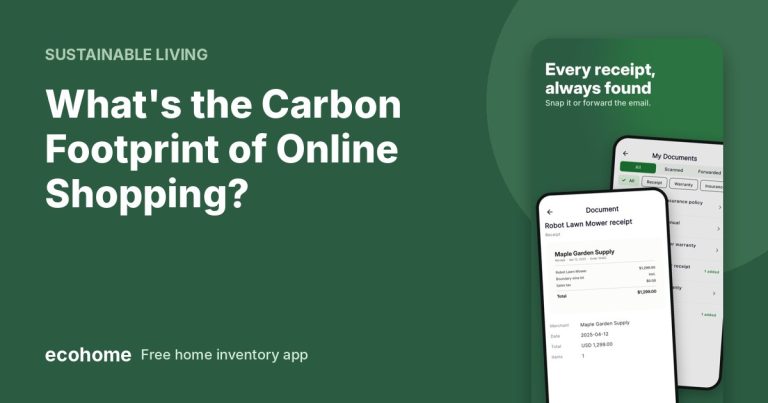
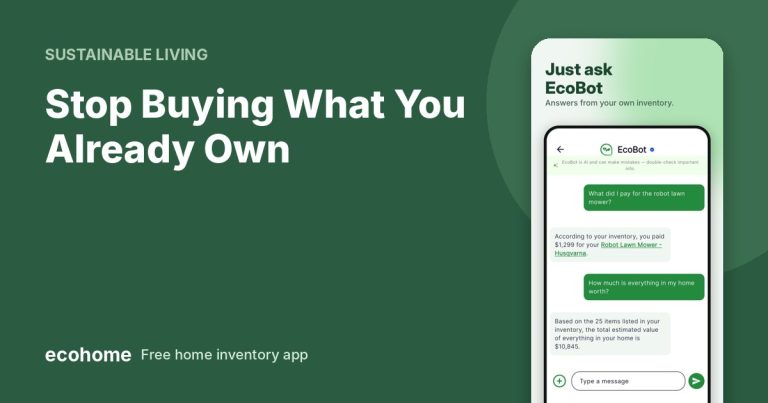
Add items by taking a photo, and AI fills in the details, or scan a barcode. Organize them by room or category, across more than one home if you need to. You can also forward receipt emails to your household’s private address, and ecohome reads the email, adds the items it finds to your inventory, and notifies you when it’s done. Or connect Gmail, Outlook or Yahoo, so receipts come in without typing. When you wonder whether you already own something, search, or ask EcoBot, the assistant that answers from your own inventory, receipts and documents.
Look after it on time
ecohome suggests maintenance schedules for your home and the items in it, tuned to your local climate. Enter your ZIP code (or PIN code) so the schedule fits your local climate. ecohome reminds you 7 days before a job is due and again on the due date. In the US, it also shows weather alerts from the National Weather Service and local rules with links to official sources. Renting? Tell it you rent and the jobs that are usually your landlord’s are marked. You can see how it works on our home maintenance reminders page.
Share it, rent it or sell it
Lend things to, and borrow from, people you know. Rent an item out by the day, week or month, or sell what you no longer use. Household members are free, so everyone at home can see what’s already there before they buy.
Get credit for good habits
ecohome awards badges for organizing, sharing and reuse, home care, and saving. They’re a small, friendly nudge to keep going.
Start small
You don’t need to inventory the whole house this weekend. Pick one room, or one category you know you re-buy. Add those items, set up the maintenance reminders for your biggest appliances, and note one thing you’d be happy to lend. That’s enough to start using what you already own a little better.
Curious what else the app does? See every feature.
Help shape ecohome, and get some merch
Have an idea for a feature, or found a bug? Tell us. We send ecohome merchandise to people who share a feature request, report a bug or invite five new people to ecohome. See how rewards work.
For sealing drafts and getting your heating ready, see our fall home checklist by climate.
Get more from what you already own
Track what you have, keep it maintained and share what you rarely use. Free on iPhone, Android and the web. No credit card.

Or use it in your browser at web.ecohome.one.