Know Your Carbon Footprint at Home — Without the Spreadsheet
Know Your Carbon Footprint at Home — Without the Spreadsheet
The carbon you can change is hiding in the stuff you already own.
When most people think about their carbon footprint at home, they think about the meter on the wall. The thermostat. The utility bill. Those matter, but they’re a small part of the picture — and the smallest part you can change.
The biggest piece of your household carbon footprint is locked into the things you already own. The manufactured emissions of a sofa. The packaging and shipping of a laundry hamper. The materials in a coffee maker. These are sometimes called embodied emissions, and they’re invisible — until you start looking at your home as an inventory rather than a habit.
The simple insight: own less, replace less often, share more
Sustainability advice usually focuses on what you buy next — recycled materials, energy-efficient appliances, ethical brands. That advice is real, but it underweights the bigger lever: everything you already own represents emissions you’ve already paid for. The most carbon-efficient item in your home is the one you don’t need to buy because you already had one.
That’s why home inventory is sustainability work. Not in a fluffy way — in a measurable way. When you know what you own, you:
- Buy duplicates less often. (You won’t buy a third measuring cup if you remember you have two.)
- Extend the life of what you have. (Maintenance reminders surface before things break.)
- Replace strategically. (When you do replace, you replace what’s actually worn out, not what someone advertised at you.)
- Share and lend within your household and community, instead of every person buying their own.
How ecohome turns inventory into carbon visibility
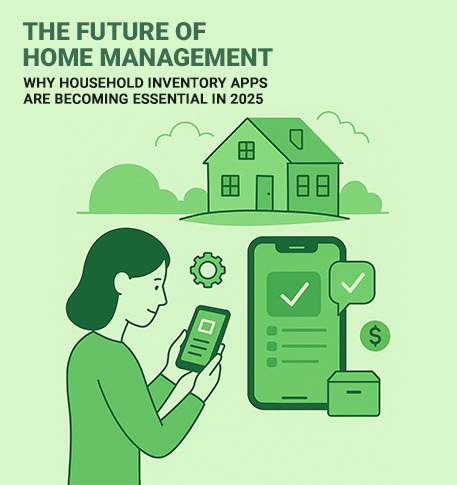
ecohome tracks what’s in your home and what came in. That’s the same data you need to understand your household’s carbon footprint, just framed differently. The same photo you took to inventory the new coffee maker tells you: when did this enter the home, how often is it used, and is there one you could share with a neighbor instead of buying a second one?
A few specific ways this works in the app:
- Category insights. Once your inventory is built, you can see what you have a lot of — and what you’d quietly be happier without.
- Receipt forwarding. Every Amazon order, every Costco run, every grocery receipt forwarded to your household address becomes part of your purchase history. You start noticing patterns — including the impulse buys.
- Rewards and sharing. The Rewards program celebrates sharing, lending, and reusing. We send real merchandise — manufactured once, shipped USPS — for behaviors we want to encourage.
- Maintenance reminders. A working appliance lasts twice as long when it’s maintained. ecohome surfaces reminders before things break, which means fewer replacements over the life of a household.
What changes when you can see it
It turns out that the act of writing things down — even via a camera and AI — shifts behavior. Households that use a real inventory tend to make fewer impulse buys, share more between rooms and people, and notice the things they own but don’t use. That noticing is where the carbon math starts to bend.
None of this requires you to become a different person or audit your home with a spreadsheet. It just requires a tool that makes “what’s in my home” a question you can answer quickly. ecohome is that tool.
The nudges that bend the curve
The math on household carbon doesn’t shift because you read an article. It shifts because the right reminder shows up at the right moment. A few of ecohome’s nudges are explicitly designed for this:
- Duplicate-purchase nudge. When a forwarded receipt looks like a near-match for something you already own, the app flags it. The most carbon-efficient purchase is the one you decide not to make.
- Maintenance nudge. Appliances and tools last roughly twice as long when they’re maintained. Pre-failure reminders mean fewer replacement cycles per decade of household life.
- Right-size nudge. When a category in your inventory grows past what a household reasonably uses, ecohome surfaces it. Visibility is the prerequisite to lending, sharing, or letting go.
- Share-it nudge. Through our Rewards program, the app recognizes when an unused item could go to a neighbor, a community share, or the secondary market — and walks you through it.
None of these nudges shout. They appear when relevant, are honest about their reasoning, and are easy to silence if a category isn’t useful to you.
See every feature, or download it free for iPhone, Android, or the web: